


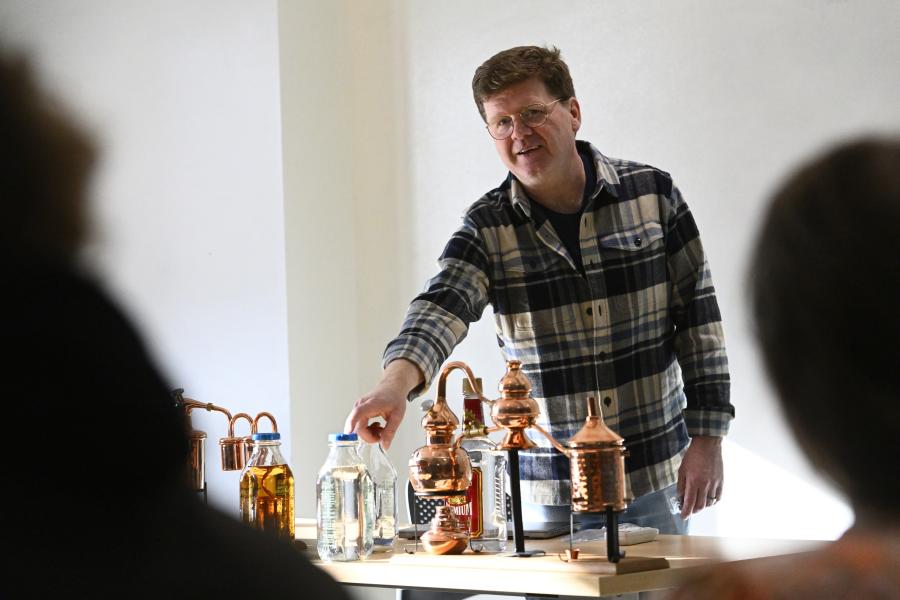
At first glance, the lab seems normal. Undergraduate students are gathered around copper apparatuses, fiddling with hot plates as they wait for something to happen.
And then the first sweet-smelling drops appear.
In senior lecturer Eric Johnson's Intersession course, The Angel's Share, students are learning a chemical process that's thousands of years old: distilling liquor. The five-day class teaches undergraduates the science of fermentation, distillation, and aging, complete with hands-on practice and a tour of the Baltimore Spirits Company distillery.
Video credit: Aubrey Morse / Johns Hopkins University
Although tasting the experiments isn't allowed, the class has been a big hit with students. Senior Jacquelyn Slade, who studies political science and jazz voice performance, loves taking a closer look at a process she took for granted.
"I never knew that distilling was quite that complex," she says. "I guess I never thought of liquor distillation as something that involved a lot of science, even though maybe I inherently knew that."
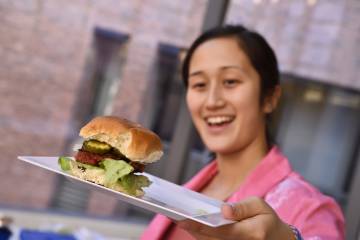
According to Johnson, it's realizations like these that make Intersession so fun. To him, the mini-semester is the perfect chance to explore real-world applications for things students are reading in their textbooks. For example, in 2020 he taught a two-week course on artificial meat substitutes that ended in a class-wide cook-off.
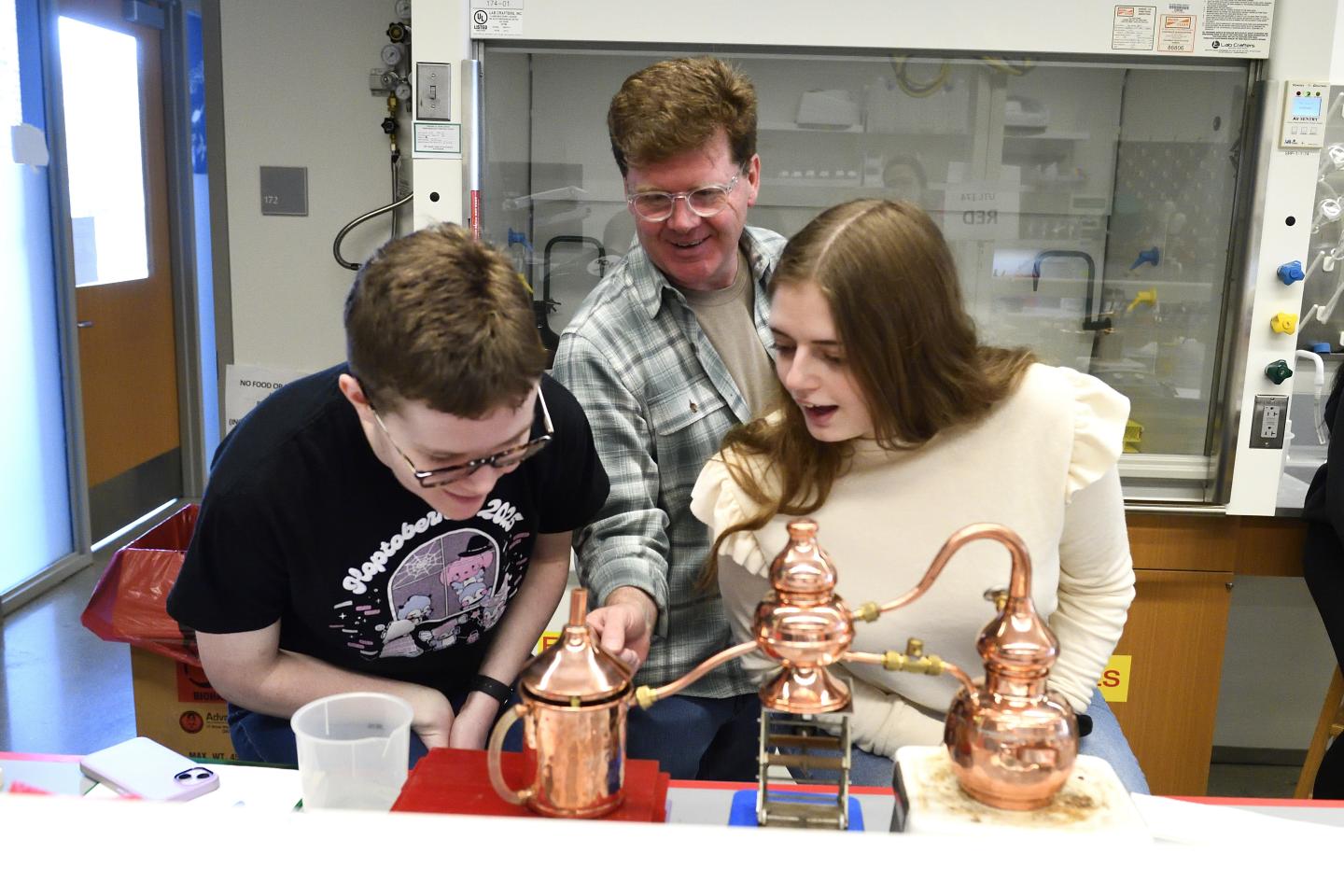
Image credit: Will Kirk / Johns Hopkins University
"I love finding topics that people can relate to, and then being able to use those topics to dig deeper into a lot of the really fascinating things that happen in laboratories and in higher education," Johnson says. "Distillation is a chemical technology, but when you're doing it with biomolecules, you have biochemistry."
With Intersession ending soon, Johnson is already brainstorming ideas for next year's course. The world of food and drink has no shortage of inspiration for a biochemist.
In the meantime, he hopes his students walk away with a new appreciation for everyday science.
"And once you can appreciate the science, then there's the whole world of art that you have a different perspective on," Johnson says. "When you look at a distiller at work, you realize that science can get you to a certain level, but there is an art in what happens in that bottle."
Posted in Science+Technology, Student Life
Tagged intersession, alcohol, undergraduate education