




The SNF Agora Institute is offering a series of Intersession courses this January exploring democracy through the lenses of media, innovation, and global action. These offerings will connect theory to practice, giving students opportunities to study how people build trust across difference, use information responsibly, and strengthen more inclusive and resilient communities.
Held during the two weeks before the spring semester, Johns Hopkins University's Intersession program invites undergraduates to immerse themselves in concentrated, discussion-based learning during short, intensive courses taught by Johns Hopkins faculty and visiting experts.
This year's SNF Agora courses will be taught by visiting fellows Amy Becker, David Park, and Félix Maradiaga. Each instructor will bring a distinct perspective, encouraging students to see democracy not as an abstract system but as something they shape every day through creativity, collaboration, and civic participation.
Political Comedy and Entertainment: Saving or Stifling Democracy?
In Political Comedy and Entertainment, Loyola University Maryland professor of communication Amy Becker will examine the connection between humor and civic life.
"Comedy still has the potential to engage people, but it needs to adapt," says Becker. "Young people aren't watching television anymore. They're seeing clips on TikTok. The political comedians have to meet them there."
The class will study how satire and parody influence civic understanding.
"When people first started researching political comedy, the question was whether it was good or bad for democracy," Becker says. "I think we've moved beyond that. It does some good things, but now the question is how it can continue to do good things as the media environment changes."
Using AI to Streamline E-Waste Management in Baltimore
Urban policy strategist David Park will connect technology to civic problem-solving in his upcoming course: Using AI to Streamline E-Waste Management in Baltimore. Park is director of data and business analytics at the National League of Cities, where he helps more than 2,500 U.S. municipalities use data to improve quality of life.
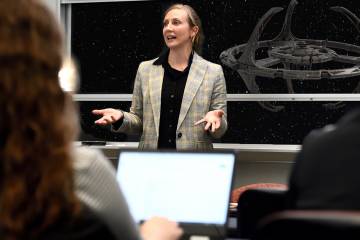
"We're literally sitting on a mine of precious metals and rare earth materials that have value, but we're not doing anything with it," he says. "This is a social problem as much as a technical one. The technical part isn't hard. It's changing behavior that's difficult."
Students will work in teams to design artificial intelligence tools that help Baltimore residents recycle old electronics, assist city workers in identifying hazards, and support local leaders planning a circular economy.
Frontlines of Freedom: Civil Society's Role in the Global Democratic Ecosystem
In Frontlines of Freedom, activist Félix Maradiaga will introduce students to the power of organized citizens in resisting authoritarianism.
Maradiaga is this year's SNF Agora dissident in residence and a Nicaraguan human rights advocate known for his expertise in nonviolent resistance. His course will explore how pro-democracy networks collaborate across borders, sustain themselves under pressure, and offer universal lessons for strengthening democracy.
Registration for Intersession courses is open to all Johns Hopkins undergraduates through the university's course catalog.
Posted in Politics+Society
Tagged intersession, snf agora institute, undergraduate education, democracy