


The healthiest diet we can eat is also a diet that bolsters the health of our planet, says nutrition and food policy expert Jessica Fanzo, who co-led a major report on food systems and planetary health released this past October.
The report—EAT-Lancet 2.0, released by the 2025 EAT-Lancet Commission—builds on the landmark 2019 Lancet study that introduced the "planetary health diet," an eating regimen high in fruits, vegetables, legumes, and nuts—and lower in animal foods, which take a toll on the environment.
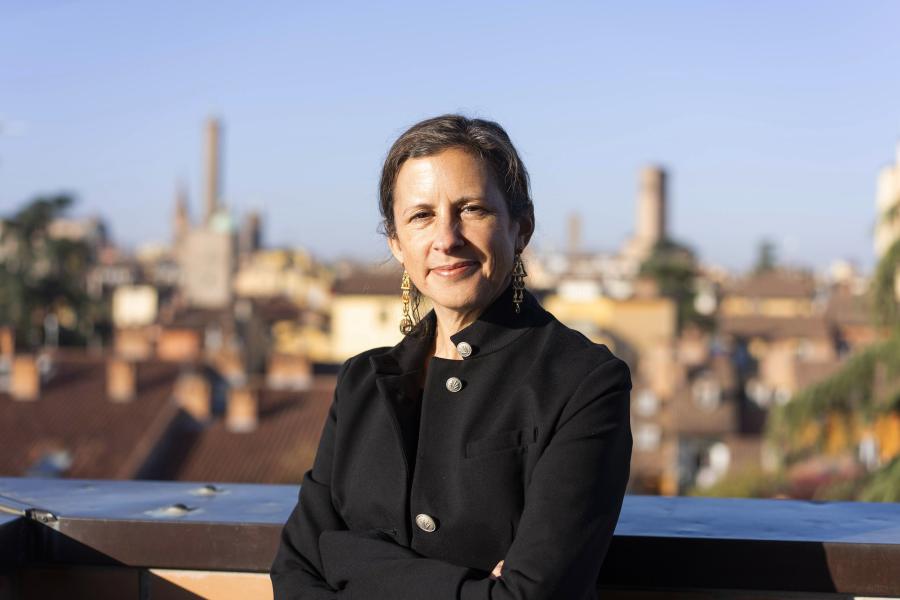
This month, Fanzo returns to Johns Hopkins as the inaugural James Anderson Professor of Food Policy and Climate at SAIS Europe, after two and a half years as director of Columbia University's Food for Humanity Initiative. From her new base in Bologna, Italy—just a train ride from Rome, where the United Nation's major agencies are headquartered—Fanzo will position Johns Hopkins as a leading academic partner with global organizations working to evolve food systems to promote healthy, sustainable, and equitable eating.
"I'm grateful to return to Hopkins at SAIS Europe in Bologna, a community of deeply engaged students and scholars who think creatively about the challenges ahead," Fanzo says. "Europe is an important center of gravity for food and climate policy, and I'm excited to contribute to that work, while teaching and learning alongside colleagues who use science to make meaningful differences."
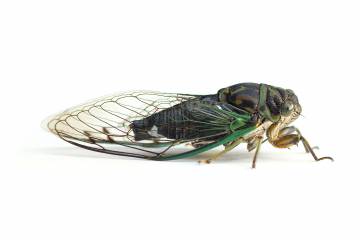
Fanzo is a familiar face at Johns Hopkins. A JHU Bloomberg Distinguished Professor of Global Food Policy and Ethics from 2015 to 2023, she served up crunchy, protein-rich cicada recipes in her popular book Can Fixing Dinner Fix the Planet? (JHU Press, 2021). The book draws on her decades of hands-on research in Africa, Asia, Europe, and the Americas, building a case for altering our food systems to drive human and planetary health through sustainable, equitable eating.
"We're delighted to welcome Jess Fanzo back in this timely position," says James B. Steinberg, dean of the university's School of Advanced International Studies. "Her pathbreaking scholarship and leadership in global food systems and climate policy embody the values of our university, and her presence at SAIS strengthens the school's role as a bridge between academic research and the institutions shaping policy in Europe, the United States, and around the world."
A blueprint for sustainable food systems
As Fanzo builds what she envisions as "a think-tank of sorts" in Bologna, she plans to help push forward the findings shared in EAT-Lancet 2.0. For one, the report says, the systems we employ around food, from farming and harvesting to packaging, transporting, and managing waste, contribute 30% of the world's greenhouse gas emissions. In order to prevent a global temperature increase of more than 1.5°C—the threshold identified in the 2016 Paris Climate agreement for limiting climate-fueled catastrophes such as floods, droughts, wildfires, and storms—what we eat needs to be a major part of the equation.
According to the report, 40% of Earth's land is used to grow food, and as much as 75% of that land is used to produce animal feed like alfalfa and hay. "This is inefficient, given that roughly 20% of the calories consumed by the world come from livestock, whereas the other 80% come from plants," Fanzo says.
What's more, cattle ranches and livestock production often involve deforestation, already a crisis-level problem in places like the Amazon rainforest and the Congo Basin, an area in west-central Africa that houses the second largest rainforest in the world. "If we lose places like this, then we lose both the biodiversity and the massive carbon sinks they offer," she says. "Without these carbon sinks, CO2 gets released in the atmosphere and accelerates global warming."
An ideal diet
The new report's dietary recommendations, supported by decades of evidence, is largely the same as the 2019 recommendation. The planetary health diet is intentionally flexible and designed to accommodate differences in nutritional needs, food systems, and cultural and personal preferences, whether one eats a vegan, vegetarian, pescatarian, or omnivore diet, Fanzo says.
Daily, it recommends:
- Five servings of fruits and vegetables
- Two servings of nuts
- Two to three servings of legumes or beans
- Three to four servings of whole grains
- One serving of dairy
Weekly, it suggests no more than:
- Two servings of poultry or fish
- One serving of red meat
- Two eggs
For many people, the diet's limit on animal products would require a significant shift in eating patterns. The real challenge, Fanzo says, is breaking a habit of many high-income countries: centering every meal around beef, pork, or another meat. "Do you need bacon for breakfast?" she asks. "Can you just have a yogurt or something lower on the food chain? Can you have cereal and fruit?"
The recommendations differ starkly from the new U.S. dietary guidelines, which emphasize "real food" while advising Americans to prioritize protein (especially nutrient-dense beef) at every meal. "These recommendations go against 50 years of science on human health and totally ignore factors relating to extreme weather and climate change brought on by a warming, stressed planet," she says. "The new U.S. dietary guidelines are not considering the environment at all."
The planetary health diet does the opposite, however, because "we created it based on dual outcomes—the health of humans and the planet we live on," she adds.
Addressing the findings of EAT-Lancet 2.0 is a tall order, and to pull it off, global policymakers and government leaders will need to get involved, Fanzo says. Individual action, though important, won't be enough on its own.
"We can all do things individually, and that matters—for our own health, our family's health, and our planet's health," she says. "But we're at a point in the world where we need some macro changes, and what matters most is electing leaders who care about and value human and planetary health."
Posted in Politics+Society
Tagged jessica fanzo, sais europe, food systems, planetary health