


- Name
- Hannah Robbins
- hlrobbins@jhu.edu
- Cell phone
- 667-232-9047
Baltimore-area residents felt safer in their neighborhoods this year, according to the most recent Baltimore Area Survey report from Johns Hopkins University's 21st Century Cities Initiative.
The survey, which is in its third year, also shows city and county residents were more pessimistic about the local economy and more anxious about the job market than they had been in years past.
"Baltimore has seen major changes in the past couple of years, including the Key Bridge collapse, but one of the biggest may be the substantial declines in crime," said report author Michael Bader, an associate professor of sociology and faculty director of the 21st Century Cities Initiative at Johns Hopkins. "It's important we understand how these changes reshape daily life for our neighbors and local communities."
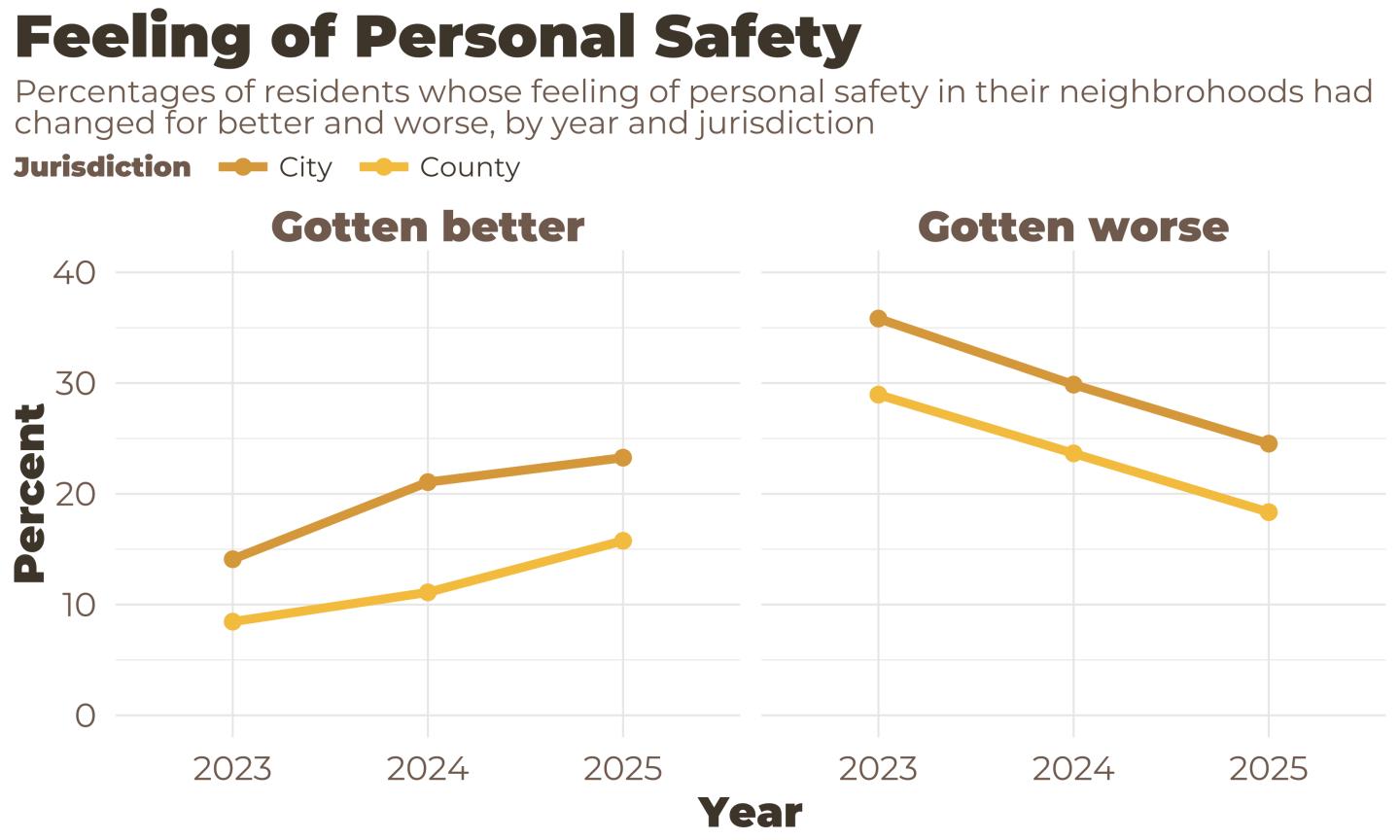
Image credit: Johns Hopkins University
Since 2023, Bader and his colleagues have been working with Baltimore community leaders to co-design a survey that would help them better understand how residents experience living in the area. In the late summer and early fall of 2025, they surveyed 748 residents of Baltimore City and 523 residents of Baltimore County about access to food and transportation, their neighborhoods and local schools, trust in various governments and satisfaction with the services they provide, and the local economy.
Most Baltimore-area residents were satisfied with their neighborhoods. More survey respondents felt their personal safety had improved and fewer felt their safety had gotten worse than in the previous two years. About one in five area residents felt their safety had improved in 2025, up from one in eight in 2023.
Additionally, people were just as content with the schools in their neighborhoods as they were last year.
"With three years of data, we can finally tell if what we're seeing looks like a trend or something that is more of a weird blip or an anomaly for any given year," Bader said. "We can see that overall feelings of safety have been steadily improving. While there is still progress to be made, this is a positive sign that residents are feeling safer and more satisfied in their neighborhoods."
Other key findings include:
Baltimore-area residents were worried about job security and the job market.
- More than a third of employed residents worried about losing their jobs.
- Just under half of all employed residents worried about finding a job as good as their current one, compared to a third of employed residents two years ago.
- Nearly half of residents who experienced high transportation insecurity worried that the lack of reliable transportation would severely hinder a job search.
People were more anxious about the local economy, and most think that economic conditions in the region are getting worse.
- More than 55% of survey respondents felt the local economy was getting worse, and almost 70% said the United States economy was getting worse.
People lost some trust in government at all levels, though not necessarily in the services that governments provide.
- Baltimore-area residents have lost more trust in the federal government than in state or local governments. Compared to last year, the percent of people who would never trust the federal government to do what is right increased by 24 points—a number two times higher than the increase in people who feel the same way about state and local governments.
- Residents in the city and county showed similar levels of satisfaction with public transit, schools, policing and sanitation in 2024 and 2025, indicating that satisfaction with government services remained steady even as trust wanes.
Baltimore-area residents experienced more food and transportation insecurity this year, with the poorest households experiencing the most hardship.
- Nearly half of Baltimore city residents were food insecure this year, and more than half of those people were very food insecure based on a measure defined by the U.S. Department of Agriculture. More than 30% of county residents experienced food insecurity.
- Black Baltimore-area residents experienced the sharpest increase in food insecurity. In 2025, nearly 58% of Black residents were food insecure, compared to 38% in 2024 and 54% in 2023.
- The poorest households in the Baltimore area experienced the highest levels of food and transportation insecurity. For households making less than $30,000 a year, roughly 75% experienced food insecurity and 60% experienced transportation insecurity.
Read the reports
Posted in Politics+Society
Tagged sociology, economy, baltimore, 21st century cities, baltimore city