



Susanne Sterbing, assistant research professor in the Department of Psychological and Brain Sciences at Johns Hopkins University's Krieger School of Arts and Sciences, died of cancer at Gilchrist Center in Towson, Maryland, on Jan. 1. She was 60.
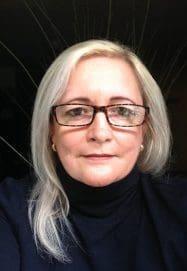
Image caption: Susanne Sterbing
Sterbing was widely recognized for her comparative studies of the auditory and somatosensory systems of diverse species, including rodents, primates, and bats. She was a meticulous scientist, devoted teacher, and deeply respected colleague.
"Susanne had vast knowledge of everything under the sun, ranging from neuroanatomy to ecology, and martial arts to Formula 1 auto racing," said Cynthia Moss, professor in the Department of Psychological and Brain Sciences and director of the Krieger School's Comparative Neural Systems and Behavior Laboratory—better known as the Bat Lab—of which Sterbing was a member. "She was a rigorous and creative scientist who made many key discoveries in the field of sensory neuroscience. She was also a long-time research collaborator and loyal friend."
Interested in the neural basis of sensorimotor integration and spatial perception, Sterbing studied echolocating bats, as they actively probe the environment with sonar signals that can be recorded and directly tied to behavioral state.
Bats, she noted, exhibit a wide array of solutions to the challenges of orienting and maneuvering in cluttered environments. Somatosensory signaling of airflow along the wing membrane contributes to their exquisite flight control, but successful navigation in the dark must also engage multisensory processes that guide a suite of adaptive motor behaviors. So sensory-motor specializations and biomimetic solutions of multisensory processing for autonomous robotic platforms were of particular interest to Sterbing.
Sterbing also worked with primates and rodents to study sound localization using real and virtual acoustic environments, and created novel approaches to study neural mechanisms in several sensory systems.
"As a member of the Psychological and Brain Sciences, Behavioral Biology, and Neuroscience programs since I was a postdoctoral student, I have had the privilege of working with many phenomenal individuals, and Dr. Susanne Sterbing ranks among the best," said Linda Gorman, teaching professor emeritus. "When Susanne began teaching for our programs in 2018, she was a godsend and definitely played a role in my decision to retire early. Her passion for teaching and her focus on the students and what they needed made it easy to leave some of my favorite classes in her very capable hands. The Hopkins community will definitely miss her."
Sterbing's deep work ethic and conscientious approach to both teaching and research were balanced by her broad interests and sharp wit.
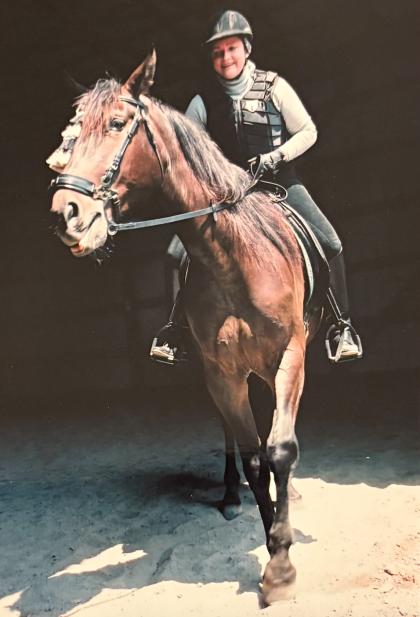
Image caption: Susanne Sterbing riding a horse
"Susanne had many interests and expertise beyond neuroscience—she was an exceptional equestrian, could answer any trivia question on Star Trek (and had her own Tribble), and was a multi-talented artist (sculptures, etchings, and more), as well as a naturalist," said Kirsten Bohn, assistant research professor in the department and chair of the Program in Behavioral Biology. "It is so rare to meet, much less have the privilege of spending so much time with, someone with such diverse passions and knowledge."
Jason Trageser, associate teaching professor in the department, recalled when Sterbing revamped the lab manual, adding the Latin derivations of many anatomical structures. "She didn't do this sort of thing because we intended to test students on it," he said, "but simply because she thought some students would appreciate it. Those little details, along with her almost impish sense of humor, were her hallmark."
Sterbing earned an MS at the University of Bonn, Germany, in 1991, and a PhD at the University of Bochum, Germany, in 1995. She served as research faculty at the University of Connecticut from 2000 to 2003, and at Vanderbilt University from 2003 to 2007. In 2007, she joined Moss's lab at the University of Maryland, College Park, and moved with the lab to Johns Hopkins in 2014. She taught undergraduate courses in the Department of Psychological and Brain Sciences and the programs in Behavioral Biology and Neuroscience, including her popular course in neuroethology.
Sterbing received grants from the Deutsche Forschungsgemeinschaft in Germany, the Air Force Office of Scientific Research, the National Science Foundation, and the Rubenstein Fund for Hearing Research. She was also part of a Johns Hopkins Discovery Award and a Hopkins IDIES seed funding award.
Posted in Science+Technology, University News