



Johns Hopkins University Provost Ray Jayawardhana, who has guided the university's expansive academic and research portfolio during a critical period in higher education, has been appointed the next president of the California Institute of Technology. Jayawardhana will assume his role at Caltech effective July 1.
JHU President Ron Daniels announced the appointment in a message to faculty, staff, and students Tuesday, expressing appreciation for Jayawardhana's leadership and contributions to the university's academic mission.
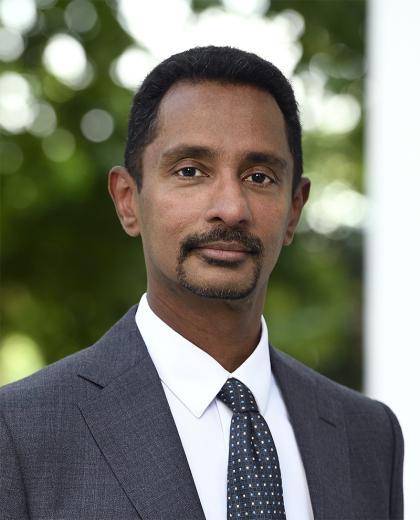
Image caption: Ray Jayawardhana
"During his tenure at Johns Hopkins, Ray partnered with me and colleagues across the university in navigating a shifting landscape in higher education while advancing our shared aspirations for the university," Daniels wrote. "While we will miss Ray's leadership and service to Johns Hopkins, we are excited for him and for the Caltech community he will soon lead."
Jayawardhana succeeds Thomas F. Rosenbaum, Caltech's ninth president who has served in the role since 2014.
"Ray is a leader of exceptional distinction who brings a complement of qualities—as a pioneering astrophysics researcher, respected university administrator, and compelling science communicator—that together will ensure Caltech builds on its legacy of transformational research and exploration to benefit humanity," said David W. Thompson, chair of Caltech's board of trustees. "The board's unanimous decision reflects our confidence in Ray's ability to chart Caltech's future—advancing our mission, inspiring our community, and elevating the Institute's global impact."
A distinguished scientist and dedicated academic leader, Jayawardhana came to Johns Hopkins in October 2023 from Cornell University, where he served as dean of the College of Arts and Sciences, Hans A. Bethe Professor, and professor of astronomy. Prior to his time at Cornell, he was dean of the Faculty of Science at York University in Toronto, following 10 years on the faculty at the University of Toronto, where he held a Canada Research Chair.
Throughout his time as provost, Jayawardhana remained an active scientist, continuing his research on exoplanets and the origins of stars, planets, and brown dwarfs, and serving as a science team member for the James Webb Space Telescope's Near Infrared Imager and Slitless Spectrograph (NIRISS) instrument.
At Johns Hopkins, Jayawardhana partnered with colleagues in university leadership and across the institution to bolster and sustain JHU's research efforts, including through the development of the Pivot and Bridge Grants for faculty facing funding gaps, the PhD Thesis and Postdoctoral Research Completion Grants, and increased Summer Provost's Undergraduate Research Awards. He also collaborated with the Johns Hopkins University Council on a range of timely matters and worked with deans and faculty in the new School of Government and Policy, the School of Education, the Whiting School of Engineering, and the Krieger School of Arts and Sciences to establish or strengthen academic appointment and promotion procedures.
In addition, under Jayawardhana's leadership, the provost's office took steps to harmonize research administration across the university and medicine, advanced shared research facilities planning, and partnered with leaders in Johns Hopkins IT to strengthen universitywide data use and access and to expand AI tools, including the development of HopGPT.
As chair or co-chair of several major leadership searches, Jayawardhana stewarded the appointments of the deans of the School of Medicine, the Bloomberg School of Public Health, and the inaugural dean of the School of Government and Policy. He also advanced key priorities of the university's Ten for One strategic framework, notably the Data Science and AI Institute, working closely with colleagues to appoint the inaugural director, expand the university's high-performance computing capacity, and recruit leading faculty, including within the DSAI-aligned research clusters of the Bloomberg Distinguished Professorships program.
Daniels also highlighted Jayawardhana's role in expanding Hopkins' public engagement and creative reach.
"Through two imaginative initiatives, the Provost's Fellows for Public Engagement and the Taskforce on the Arts, Ray opened new avenues to connect Hopkins' scholarship and creativity with the world, extending the university's commitment to discovery in service of society," he wrote.
Details on interim leadership in the Office of the Provost will be shared in the near future, Daniels added.
"It has been a profound privilege to serve Johns Hopkins as provost," Jayawardhana said. "I am grateful to President Daniels for his trust and partnership, and to the extraordinary community of faculty, staff, students, and researchers whose spirit of curiosity, creativity, and ambition fuels the university's momentum and impact. I will remain a proud and enthusiastic champion of Johns Hopkins' mission, so deeply grounded in public purpose and in discovery for the benefit of humanity."
Posted in University News