



In the world of Formula One racing, the difference between first and fourth can be a matter of seconds. On Aug. 31, Isack Hadjar of Racing Bulls placed third at the Dutch Grand Prix. It was the team's first podium finish since 2021, and the first of Hadjar's career. After 98 minutes of racing, the car crossed the finish line just 3.233 seconds after the winner, McLaren's Oscar Piastri. If Hadjar had been 2.5 seconds slower, he'd have missed the podium entirely.
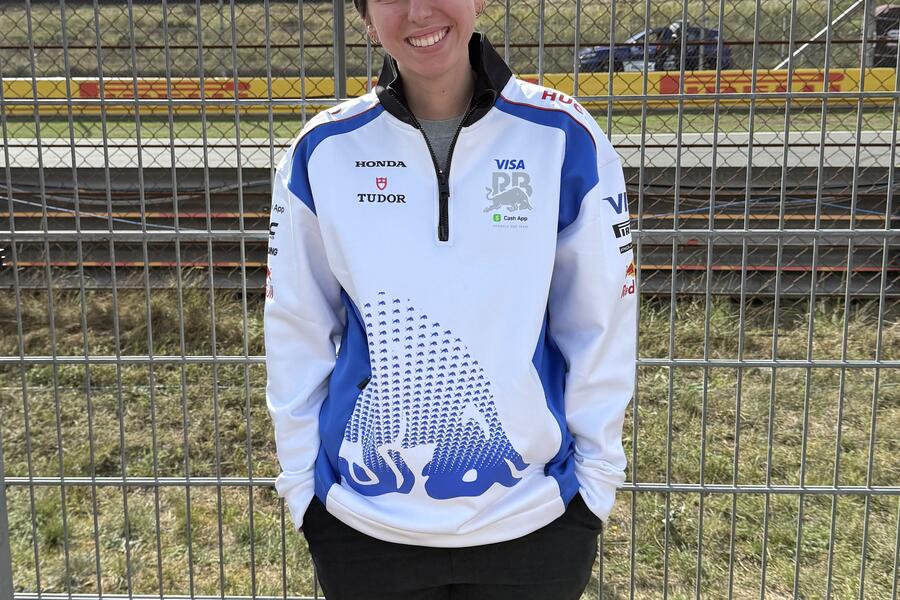
Talia Hovsepian's world revolves around these numbers. As a student data scientist for the Racing Bulls team, it's her job to optimize. Which parts of the car can be made lighter? Can the downforce distribution be improved?
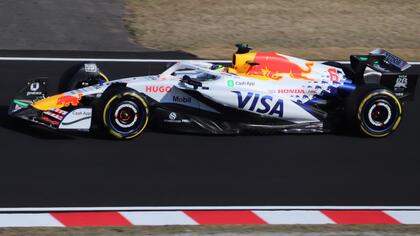
Image caption: Racing Bulls at the 2025 Japanese Grand Prix in April
Image credit: Liauzh, CC BY-SA 4.0
"There's a particular sensor on our car that we want to replace because it weighs about a kilogram, which doesn't sound like that much, but in the grand scope of the car that's like three-tenths of a second a lap," Hovsepian says. "Places one through five can be separated by two-tenths of a second, so this matters to us. How do we get the measurements that that sensor would get for us based on all of the other sensors that we have? Can we build a model that will give us these measurements instead of having to have a specific sensor for it?"
Earlier this year, Hovsepian finished up her sophomore year as an applied math and statistics student at Johns Hopkins University. As a member of Blue Jay Racing, she had some experience designing off-road vehicles.
Now, she's taking a gap year in England to work as a student placement for the Racing Bulls, a team best known for its young, up-and-coming drivers. Other parts of the team, like aerodynamic performance, approach the data scientists with a problem or idea, hoping the solution is somewhere in the numbers.
"It's almost like a project-oriented class where you have unlimited access to the professor because he sits right next to you all day," Hovsepian says. "But at the same time, they trust me with the same caliber of projects of anyone else in the group."
On race days, Hovsepian and the other student placements set up shop in the operations room. Although their headsets can hear other teams' radios, Hovsepian spends most of the race focused on the Racing Bulls driver. Sometimes, the race ends without her even knowing who won. After working so hard on the car, the team's success is her success.
"I have a direct contribution," she says. "Knowing that the car is two-tenths of a second faster because of the work that I put in is really exciting for me."
Hovsepian will return to Hopkins once her placement ends in June. In the meantime, she's living the racing fan's dream.
"These are all the things that I've been seeing on TV that I now get to have a part in," Hovsepian says. "In the entryway of our office is last year's car, so like every day I come in and I see a Formula One car and it's like, 'Wow. I actually work for this team.'"
Posted in Science+Technology, Student Life
Tagged applied mathematics, racing