



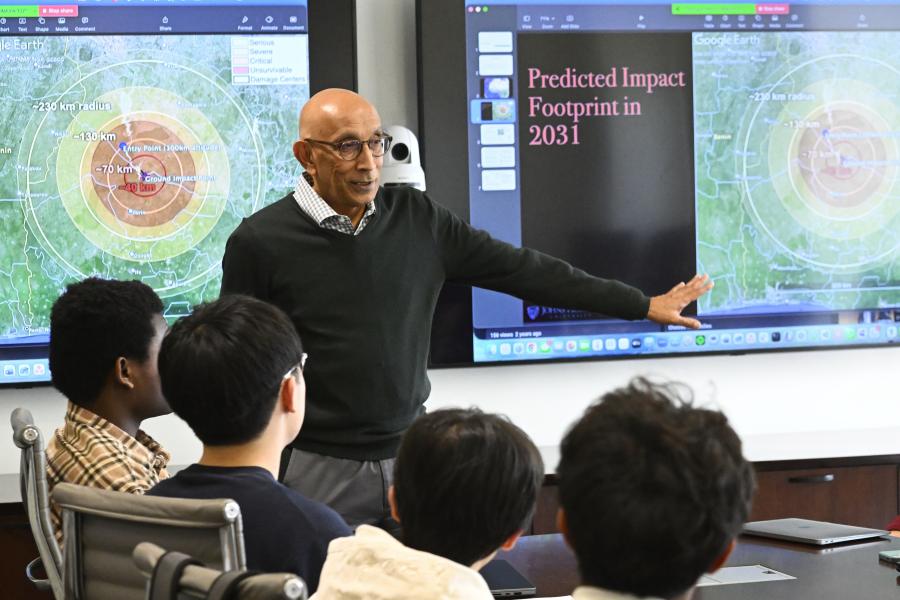
"Welcome to early 2029."
In Professor K.T. Ramesh's First Year Seminar, Defending the Planet: How to Stop an Asteroid, four years have passed in only two months. By the end of the semester, it will be 2036 and a simulated "asteroid" will hit the African continent. Unless, that is, a dozen first-year engineering students can find a way to deflect it.
Ramesh stands at the front of the class, sharing "new findings." There's a lot that the students don't know about this simulated asteroid, but a few details have crystalized. If nothing is done, impact will occur on Oct. 22, 2036, releasing between 76 megatons to 10 gigatons of energy somewhere between the Canary Islands and Angola. Everything within a 120-kilometer radius will be entirely wiped out, with serious damage for hundreds of kilometers beyond that.
The students debate among themselves. Should they send a nuclear bomb into space to deflect the asteroid, or will kinetic impact be enough? Partial deflection could knock the asteroid into North America, a risk they're unwilling to take. And what about humanitarian concerns? Can millions be evacuated from the danger zone? Will local governments cooperate?
None of this is real, but it could be someday. NASA's Double Asteroid Redirection Test, or DART, already successfully redirected an asteroid in 2022 using a spacecraft built and operated by a team at the Johns Hopkins Applied Physics Laboratory; Ramesh was on the investigative team. While that asteroid posed no hazard to Earth, it raised the question: What about the next one, or the one after that? How prepared is Earth to defend itself?
"The actual probability of having a major disaster that ends up wiping humans off the planet is extraordinarily low," Ramesh says. "It's not anything anyone needs to worry about. But the probability of having an impact that causes significant damage is actually very high. You're probably talking about decades between events rather than millions of years."
In 2013, a meteor exploded over Chelyabinsk, Russia, injuring 1,500 people and damaging 7,200 buildings. A hundred years earlier in 1908, an even larger asteroid explosion known as the "Tunguska event" knocked down roughly 80 million trees over an area of 830 square miles in remote Siberia.
While the scale of such events can be intimidating, the science doesn't have to be. As a leading expert on impact mechanics, Ramesh's research has spanned everything from planetary defense to concussions, a spectrum whose extremes are closer together than most would think.
"They're all impact problems, just impact on different things," he says. "Impact on vehicles, impact on planets, impact on people. ... From an engineering viewpoint, it's the same set of equations."
According to Ramesh, deflecting an asteroid is not unlike other engineering projects, with timelines, deliverables, datasets, and spokespeople, albeit with much higher stakes. By working through this hypothetical scenario, his first-year students learn foundational aspects of working on an engineering team, as well as the sociopolitical impact their choices can have.
It's this balance of science and policy that makes the class so interesting, says first-year student Savannah Mitchell.
"Science doesn't happen in the real world in isolation," she says. "There's always other things going on, so I think this class is a really unique experience to actually get a sense of what actual science and politics are like in the real world, how they interact, and how discoveries end up impacting people everywhere."
Ramesh isn't sure how this semester's scenario will end, but he's got faith in his team of "expert advisors."
"I'm not used to teaching freshmen. It's actually my first freshman class," he says. "These students were all born in 2008, 2007, so their understanding of the world is completely different from my understanding of the world. The way they think about it is different. ... That ability to open up and look at the big picture, they haven't had the time to do it. I think this class is an opportunity to get them to do that."
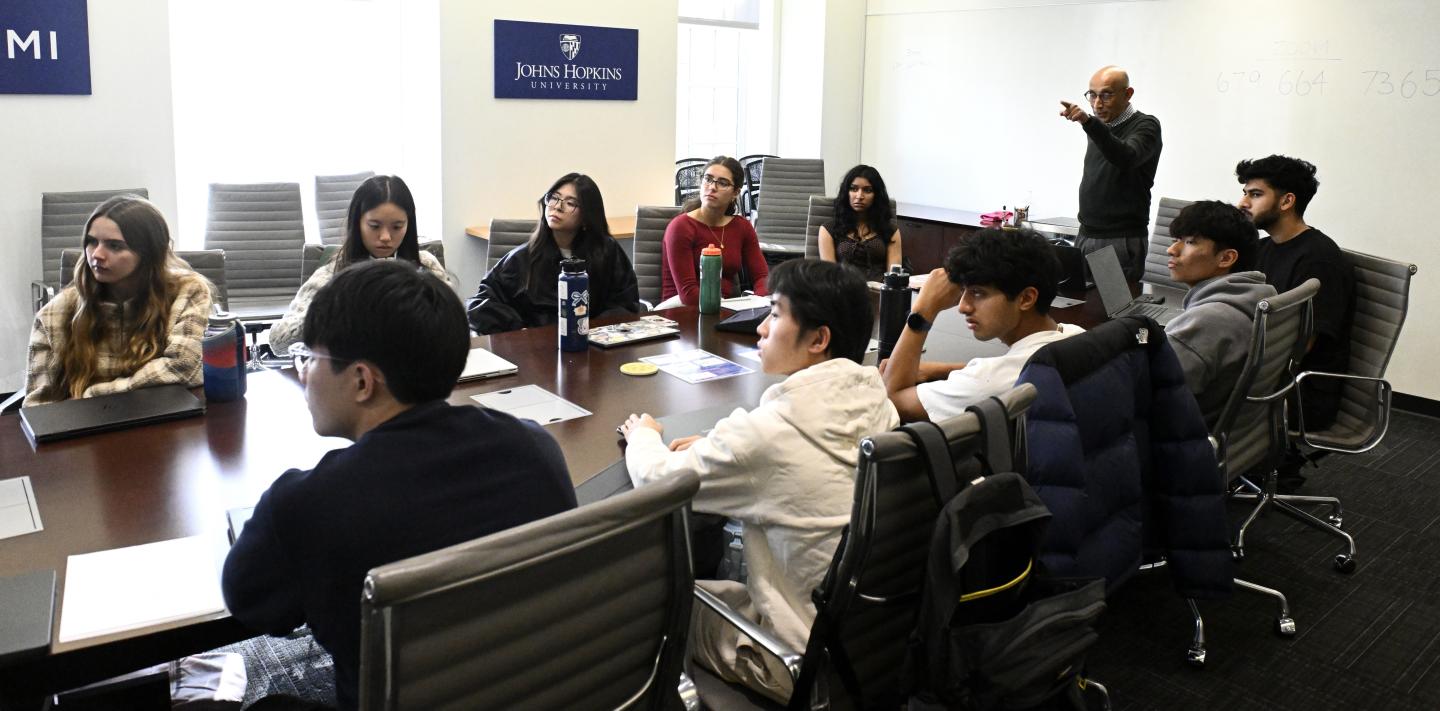
Image credit: Will Kirk / Johns Hopkins University
Posted in Student Life
Tagged undergraduate education