



LCSR Seminar | Prediction & Reaction in Motion: Humanoid Control for Non-Inertial Worlds and Athletic AI
Description
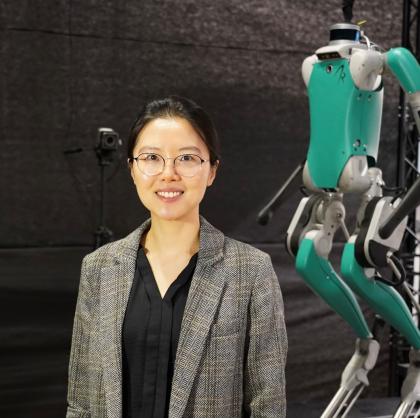
Yan Gu, an associate professor of mechanical engineering at Purdue University, will give a talk titled "Prediction & Reaction in Motion: Humanoid Control for Non-Inertial Worlds and Athletic AI" for the Laboratory for Computational Sensing + Robotics.
Abstract:
Humanoids must predict and react in unpredictable, fast-changing environments. This talk presents a unified perspective on whole-body control across two complementary fronts: dynamic locomotion and manipulation when the support surface accelerates, and athletic behavior in table tennis that compresses perception-action cycles to sub-second horizons. These fronts define an emerging research frontier in acceleration-aware, time-critical control that prioritizes anticipation, coordination, and reliable execution.
In non-inertial settings such as moving ships, airplanes, and trains, platform accelerations act as unknown, time-varying disturbances that invalidate common assumptions in modeling, state estimation, planning, and control. I will describe my group's recent advances in both model-based and learning-based approaches that enable robust locomotion on accelerating terrains. These results target high-impact applications such as shipboard operations and public-transit interventions, where reliable function requires reasoning in accelerating frames.
As a complementary stress test, athletic humanoid table tennis exposes limits in the timing and precision of existing perception and decision-making approaches. I will present an end-to-end reinforcement learning framework that maps ball observations and robot proprioception directly to coherent arm swing and footwork, relaxes common hitting-plane constraints, and achieves rapid, accurate returns with versatile two-dimensional footwork in simulation and in zero-shot hardware deployment.
I will close by synthesizing lessons across both regimes, emphasizing prediction under tight time constraints and reaction through coordinated whole-body motion, and by outlining open problems for generalizable humanoid control in highly dynamic real-world contexts.
Who can attend?
- General public
- Faculty
- Staff
- Students