


Johns Hopkins hosted its 44th annual Martin Luther King Jr. Commemoration on Friday, Jan. 16, featuring keynote speeches from United Way's Nicole Cooper and Turnaround Tuesday's Melvin Wilson. The event also honored the 11 recipients of the 2025 Community Service Award and Alvin "Joe" D'Angelo, recipient of the 2026 Levi Watkins Jr. Ideals Award.
The theme of this year's commemoration was "Impact: The Power of Communities." The event started with speeches from Theodore DeWeese, dean of the medical faculty at the Johns Hopkins University School of Medicine and CEO of Johns Hopkins Medicine, and Kevin Sowers, president of the Johns Hopkins Health System and executive vice president of Johns Hopkins Medicine.
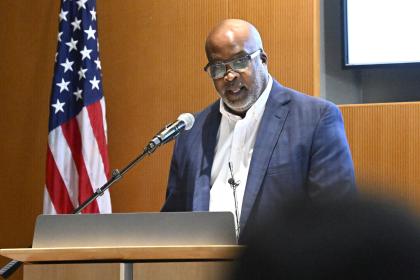
Image caption: Melvin Wilson
Image credit: Will Kirk / Johns Hopkins University
Next came a keynote speech from Melvin Wilson, executive director of Turnaround Tuesday. Launched in 2014, Turnaround Tuesday is a Baltimore nonprofit that helps un- or underemployed residents return to the workforce after incarceration. The organization has helped 2,500 people to date with a retention rate of over 70%.
Wilson spoke about his own incarceration, as well as his difficulties finding employment afterwards.
"When I returned home, I faced the reality that so many returning citizens know too well," he said. "Despite years of experience in service, my past overshadowed my potential."
It was this experience that inspired Wilson, a former police officer, to eventually build Turnaround Tuesday.
"When Turnaround Tuesday began, we had no money and no jobs, only a commitment to help people," he said. "We started by building relationships."
In 2015, Wilson met with Johns Hopkins President Ron Daniels and then-president of the Johns Hopkins Health System Ron Peterson. Since then, the university and health system have worked with Turnaround Tuesday to help Baltimore residents find secure employment.
"Community requires us to see people not as their worst moments, but as their greatest possibilities," said Wilson. "It requires institutions to move beyond charity and into partnership. It requires all of us to believe that transformation is possible when we walk together."
Wilson was followed by the event's second keynote speaker, Nicole Cooper. As the chief external affairs and transformation officer for United Way of the National Capital Area, Cooper has dedicated her career to supporting the region's many needs.
In her speech, Cooper described her upbringing in northeast Washington, D.C. She recalled seeing her neighbors in crisis because they lacked basic resources. This included her grandmother, who suffered through repeated amputations due to unmanaged diabetes.
"She tragically passed away from a medical condition that could and should have been treated better, if she had access to intervention and better care," said Cooper. "In the South, where my grandmother is from ... black patients have major amputation rates that are more than three times higher than non-Hispanic white patients. Why is that? Here in the United States, health outcomes are often shaped less by virology, and more by geography and socioeconomic factors like race, class, and income. A zip code can matter more than your genetic code. Where you live can determine directly whether you have access to quality care, nutritious food, safe housing, reliable transportation, a good job."
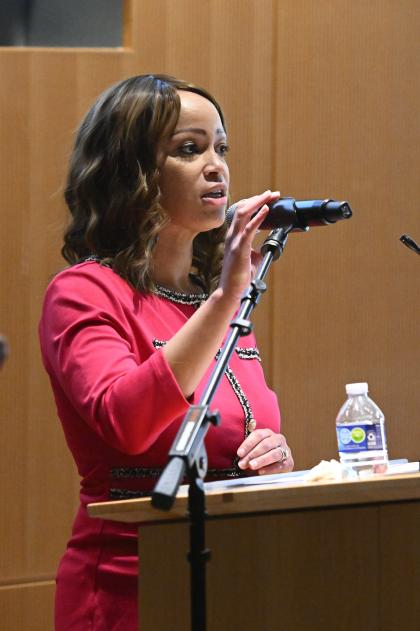
Image caption: Nicole Cooper
Image credit: Will Kirk / Johns Hopkins University
According to Cooper, it wasn't just her grandmother who suffered. The entire family experienced increased emotional, financial, and physical strain due to their caregiving responsibilities. In her grandmother's case, as with many Americans, the effects of health inequity did not end in the doctor's office.
Cooper was later selected as a Gates Millennium Scholar, which helped cover the costs of her undergraduate, master's, and doctoral education. This support enabled her to become the first in her family to graduate college.
"This experience deepened my understanding that when philanthropy is intentional, when philanthropy is equitable, it does more than fund an immediate need," said Cooper. "It lifts individuals, it lifts families, it holds communities into more secure footing. In my situation, philanthropy completely changed my trajectory of my future."
Today, Cooper uses her lived experience to support those in the D.C. area.
"Dr. King reminded us that change does not arrive on its own. It requires sustained effort, moral clarity, the courage to act, even when the work is hard and unpopular," she said. "Because when we choose equity, when we design systems that lift rather than hurt, and when we measure success by the well-being of the most vulnerable among us, we create the kind of impact that Dr. King envisioned and impressed us to do."
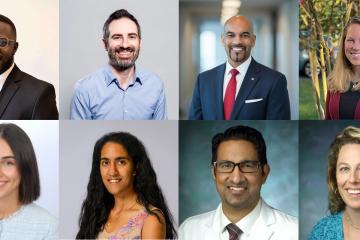
After the speeches, 11 Hopkins affiliates received the 2025 Rev. Martin Luther King Jr. Award for Community Service. This included:
Ama Apenteng, clinical research manager, Johns Hopkins University
Festus Babarinde, M.P.H. candidate, Bloomberg School of Public Health
C. Nicholas Cuneo, assistant professor of pediatrics, School of Medicine
Sarah Ernst, senior research specialist, School of Medicine Department of Pathology
Sharon Fritz, pediatric nurse clinician, The Johns Hopkins Hospital
Anicca Harriot, postdoctoral fellow, School of Medicine
Lynn Kobeissi, postdoctoral research fellow, The Johns Hopkins Hospital
Anagha Krishnan, medical student, School of Medicine
Debraj Mukherjee, associate professor of neurological surgery, School of Medicine
Kayla Otto, clinical coordinator, Johns Hopkins Care at Home
Muhammad Omar Qadir, ambulatory operations manager, Johns Hopkins Medicine
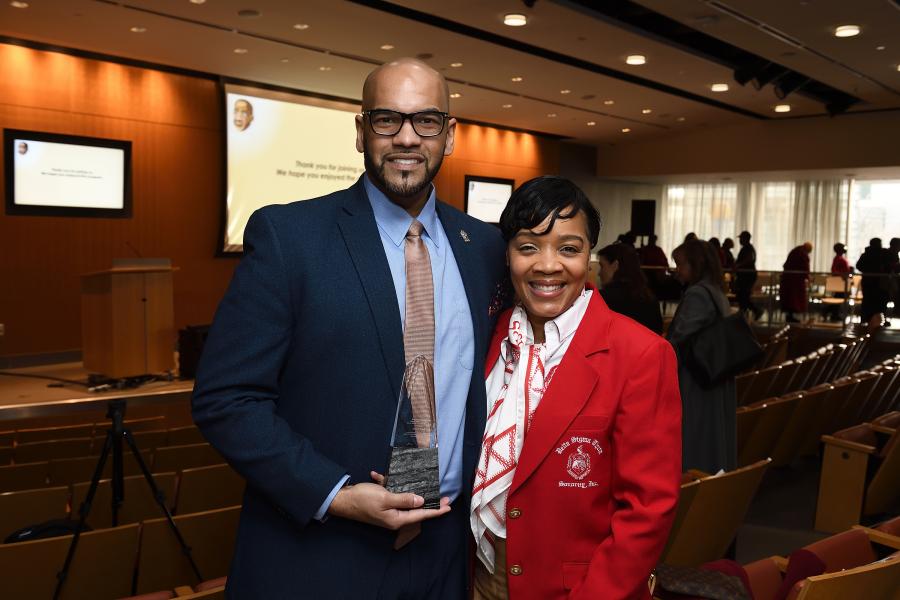
Alvin "Joe" D'Angelo, vice president of operations at Suburban Hospital in Bethesda, Maryland, then received the 2026 Levi Watkins Jr. Ideals Award for his outstanding mentorship. The award, which is named for Johns Hopkins Medicine's first Black chief resident and Black full professor, is given each year to a leader who has made a significant impact on Johns Hopkins Medicine.
The event also included a live performance from Unified Voices of Johns Hopkins, the institution's gospel choir.
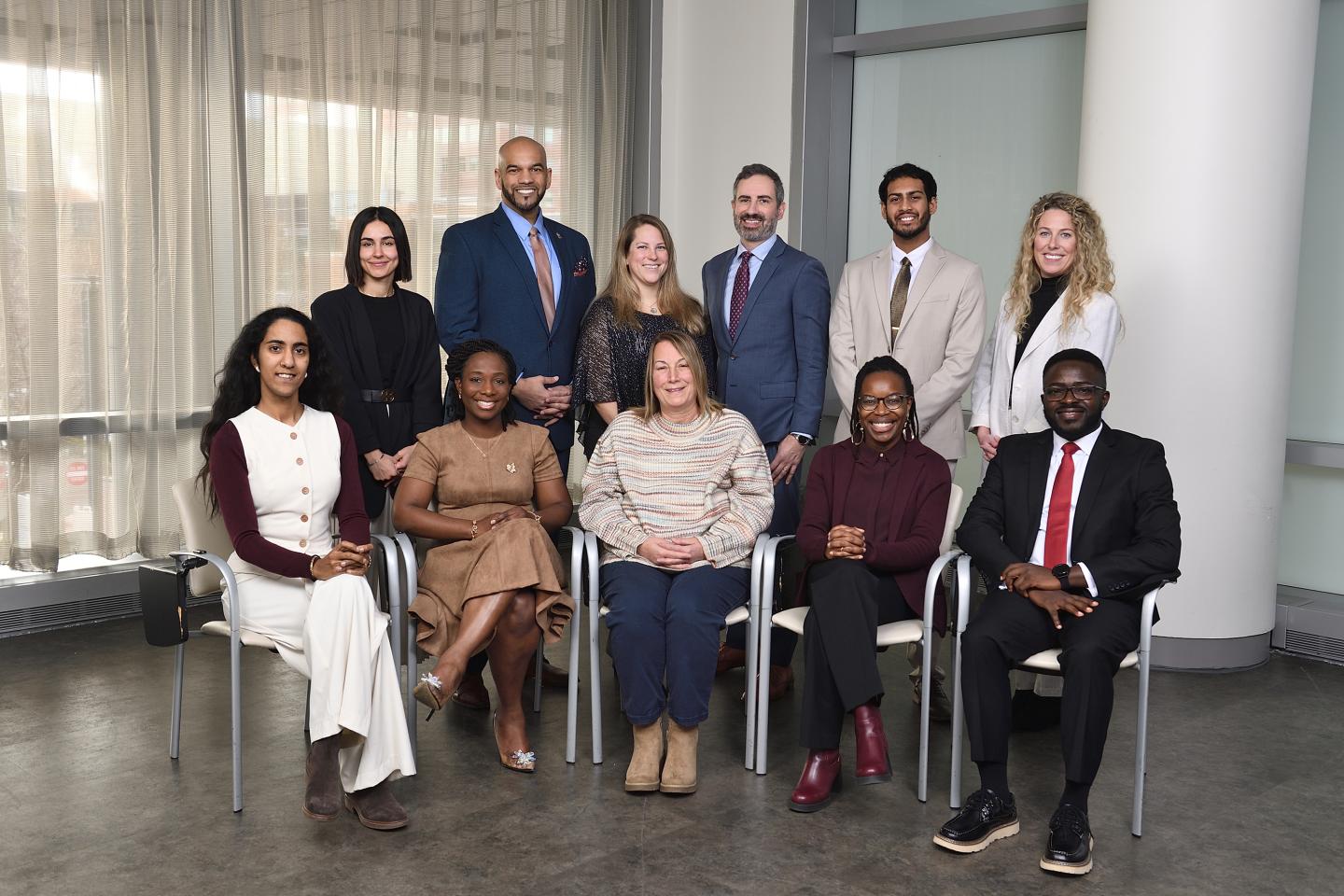
Image caption: Back row, from left: Lynn Kobeissi, Alvin "Joe" D'Angelo, Sarah Ernst, C. Nicholas Cuneo, Muhammad Qadir, and Kayla Otto. Front row, from left: Anagha Krishnan, Ama Apenteng, Sharon Fritz, Anicca Harriot, and Festus Babarinde.
Image credit: Will Kirk / Johns Hopkins University
Posted in Community
Tagged martin luther king jr., awards