


Arabic and Hebrew belong to the Semitic language family, a group of languages spoken primarily throughout North Africa and Southwest Asia, though speakers can be found all around the globe. They are some of the oldest languages in the world, with historical artifacts including cuneiform tablets from Mesopotamia and the Aramaic texts comprising most of the Old Testament. Many Semitic languages still exist today, with nearly 500 million speakers worldwide.
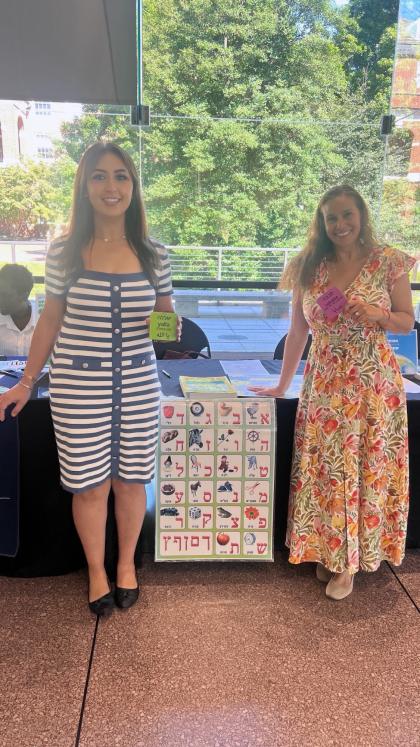
Image caption: Sana Jafire, left, and Mirit Bessire
Despite their shared ancestry, Hebrew and Arabic also represent opposite sides of a stark cultural divide defined by historic and oft-heightened tensions. A new Johns Hopkins course aims to bridge this divide by exploring their linguistic, social, and cultural similarities while exposing students to new perspectives. Offered this spring, the one-credit class will be the first in the university's history to combine the teaching of these two languages with common roots.
"I think language is one of the most powerful ways to understand other people," says Sana Jafire, Arabic language senior lecturer and one of two co-instructors for the course, Semitic Sisters—The Intersection of Arabic and Hebrew Language Learning. "Exposing our students to both languages is a great way of creating dialogue."
The commonalities between Hebrew and Arabic are vast, she adds: "Linguistics, morphology, grammar, verbs, analogies—everything is very similar."
The idea for the course came from the friendship between Jafire and Mirit Bessire, language program director and senior lecturer for Modern Hebrew. Bessire was born and raised in Israel, where she spoke Hebrew and taught the language to immigrants, while Jafire grew up in a bilingual household in Morocco; with proficiency in Arabic and French, she initially taught both languages before realizing she enjoyed teaching Arabic more. Both professors eventually settled in the United States, taking positions at Johns Hopkins.
"I heard about Sana from my students," Bessire says, "how she's so nice and communicative, so I reached out and said, 'how about we get together for a coffee?' I thought it was going to be a quick 30 minutes, but we sat for two hours."
Over the course of that initial meeting, Jafire and Bessire discovered they had a lot in common. Wanting students to discover the same kinship they felt, they pitched a five-week course to the Faculty Dialogue Innovation Fund, a universitywide grant program that supports faculty endeavors to model and teach the values and norms of dialogue across differences. Their class, designed to introduce students studying Hebrew to the Arabic program at Hopkins and vice versa, was among the projects to receive funding last year.
The course will include guest speakers and field trips designed to encourage inter- and intracultural conversations among students with different perspectives and lived experiences. One of the guest speakers, actor Ibrahim Miari, who is half-Palestinian and half-Israeli, will lead a theater workshop in class; an additional grant from the Alexander Grass Humanities Institute will allow him to perform a one-man show for the entire Hopkins community on March 8 at the Bloomberg Student Center. Field trips will include visits to a mosque in Maryland, the Diyanet Center near Washington, D.C., and a Mizrahi synagogue in New York City.
Each week, students will learn about a specific theme, with topics including Arab-speaking communities in Israel, Jewish communities in the Arab world, music, and food. The course will culminate with students presenting on what they have learned.
"I hope that we see more students register to our class with either Hebrew or Arabic speaking background," Bessire says. "I hope this class will be a start to future collaborations between Hebrew and Arabic classes. And I hope to see Arabic and Hebrew have a Semitic Languages program such as other language families do."
Posted in University News
Tagged foreign languages