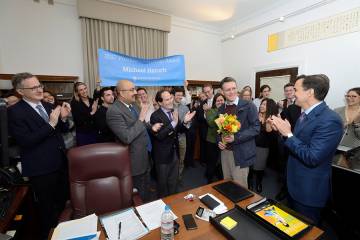




Michael Hersch, composer and professor of composition at the Peabody Institute, has been selected as the inaugural recipient of the Johns Hopkins University Affiliated Fellowship at the American Academy in Rome.
Launched in 2025 by the university's Office of the Arts, the fellowship offers one Johns Hopkins faculty member the opportunity to spend four to eight weeks in residence living and working within the academy's international community of scholars and artists. Designed to support faculty innovation, encourage creative collaboration, and expand the university's global partnerships in the arts and humanities, the fellowship was shaped by recommendations from the Taskforce on the Arts. It reflects Johns Hopkins' growing investment in artistic research and practice.
"We're excited to partner with the American Academy in Rome to open new opportunities for global collaboration for Hopkins faculty and to deepen our shared commitment to humanistic inquiry and artistic exchange," Provost Ray Jayawardhana said. "Michael is a musician of expansive imagination and artistic vision, whose compositions continually push the boundaries of musical expression, and we look forward to his new creative works that promise to enrich the Johns Hopkins community and strengthen our global connections and impact."
During his upcoming residency, Hersch will focus on two major compositional projects that explore themes of loss and reflection through classical sources. The first is a new monodrama inspired by the Philomela myth from Ovid's Metamorphoses, written for soprano Ah Young Hong—a fellow faculty member at the Peabody Institute—and mixed ensemble. The second is Symphony No. 4, a work scored for vocal ensemble and mixed instrumentation drawing on text from Sophocles' Philoctetes.
"It's a tremendous honor to be selected for the fellowship at the American Academy in Rome," says Hersch, who also received JHU's President's Frontier Award in 2017. "The partnership between the two institutions seems a natural one. Over time, I hope to have been but one of many from our community to foster discovery, conversation, and the furtherance of varied creative endeavors through the production of new work born of this dialogue."
This fellowship marks a return to the American Academy for Hersch. Twenty-five years ago, he arrived in Rome as the recipient of a highly prestigious Rome Prize, the Samuel Barber Fellowship in Musical Composition (2000-01), an experience that proved formative in his early career and helped shape the artistic trajectory that followed.
For Hersch, place is integral to the creative process, and both works he will pursue through the fellowship are rooted in classical literary traditions with deep ties to Rome.
"The environment in which a composer works can have radical impacts on productivity and inspiration," Hersch added. "This is certainly true in my case. I have no doubt that having the opportunity to work again in the environs of the American Academy, with time to focus on my work, will provide the backdrop to meaningful progress on both of these large-scale endeavors."
Work undertaken during the residency will continue to take shape after Hersch's return to Baltimore, culminating in a formal reflection on his time and work at the academy.
"Michael is a brilliant composer and musician whose work serves as an excellent example of the university's distinguished achievements in the arts," says Daniel Weiss, senior advisor to the provost for the arts. "We are delighted to provide this opportunity for faculty to conduct meaningful work in an extraordinary setting."
Posted in Arts+Culture, University News
Tagged michael hersch