


The World Health Organization declared the outbreak of COVID-19 a pandemic in March 2020, and what followed were widespread shutdowns, mask mandates, distancing recommendations, a breakneck race to develop vaccines, and the gradual decoding of a truly novel virus. The pandemic also was marked by enormous social and economic disruption and resulted in polarized responses to these public health measures and scientific expertise that persist to this day.
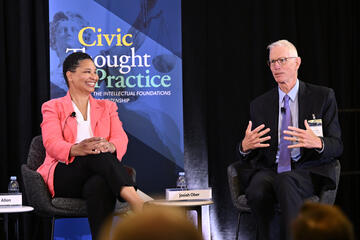
A recent symposium held at the Johns Hopkins Bloomberg School of Public Health—"Bridging Perspectives in COVID's Wake: Science, Policy, and Public Trust in Crisis Response"—offered the opportunity to reflect on the many decisions made during the pandemic, share differing views regarding their appropriateness and impact, and discuss how the nation might approach a future public health crisis. The event was co-hosted by JHU and the American Enterprise Institute, a leading center-right think tank based in Washington, D.C.
Structured around a new book by Princeton University political scientists Stephen Macedo and Frances Lee—In Covid's Wake: How Our Politics Failed Us—the event featured a conversation with the authors and panel discussions with a range of experts from across the country, including those from government, academia, and policy think tanks, to examine how scientific evidence, policy implementation, and public communication intersected during the pandemic. Panelists explored, for example, whether dissenting perspectives received a fair hearing in the public health community, and whether decision-makers adequately weighed the tradeoffs of strict isolation efforts.
Judd Walson, chair of the Department of International Health at the Bloomberg School and one of the events co-organizers, told the more than 100 in-person attendees—and many others who joined remotely via livestream—that reading In Covid's Wake produced mixed emotions for him as a career scientist and public health expert.
"There's a lot in the book I disagreed with. … I particularly struggled with assertions regarding the public health community's failure to weigh societal costs," he said, as well as the conflation of "absence of evidence of impact" with "evidence of absence of impact.
"However, I also found the book full of truths I had not considered thoroughly. There were arguments about the way we interpreted data, the way the public health community presented our conclusions and recommendations, and the great feelings of distrust that resulted from the failed communication strategies and failed political leadership that came to define the pandemic response. And it's precisely the fact that the book made me uncomfortable, that I had profound disagreements with some of the arguments, that highlights the critical importance of the discussions we will have today."
Tony Mills, senior fellow and director of the Center for Technology, Science, and Energy at AEI and also a co-organizer of the event, said that rebuilding a constructive politics of science and public health "does not mean papering over our differences, but finding a way to engage in civil, reasoned disagreement about matters of great societal moment and concern." This engagement, he added, "contributes something important to our public discourse" and was the primary purpose of the symposium.
"The hope that as the dust from the pandemic settles, we will come to a collective agreement over what went well and what went badly, has been frustrated," Mills said. "We sit here today more polarized than before the pandemic, including over how we assess the pandemic response and the institutions that were central to that."
The event was part of a broader series of collaborations between scholars at Johns Hopkins and AEI that seek to foster constructive and civil conversations across diverse perspectives on pressing issues. In introductory remarks, JHU President Ron Daniels noted that universities "are stewards of expertise and facts" that are essential to the health of a vibrant liberal democracy.
"To fulfill this role, it is essential that we are places where our ideas are being tested by those whose perspectives, experiences, and thoughts are broadly different from one another," Daniels said. "The questions posed by the book, even if uncomfortable, disquieting, or provocative, are questions that we must be willing to ask of ourselves."
Robert Doar, president of the American Enterprise Institute, echoed those sentiments and thanked Daniels for his role in helping to forge a series of collaborations that "makes Johns Hopkins stronger and us stronger."
In the opening session, Yuval Levin, director of social, cultural, and constitutional studies at the American Enterprise Institute, moderated a talk with Macedo and Lee that focused on the book's origins and why they felt such a candid assessment of how U.S. institutions fared during the pandemic was needed.
Lee said that, for her, the book was "a window into our political dysfunction" and the absence of constructive debate across spectrums of opinions. Specifically, she noted how something as simple as the origin of the virus became a hotly politicized topic that distracted the public and muddied conversations about how best to respond. In terms of "what went right," both Macedo and Lee applauded the success of Operation Warp Speed in developing a vaccine that was accessible to people across the socioeconomic spectrum.
But both criticize measures implemented before the arrival of the vaccine, including social distancing, questioning their efficacy. Lee argued at the event that there was "a non-willingness to debate, to entertain the costs, and to look at the absence of evidence for nonpharmaceutical interventions."
In subsequent panel discussions, experts reflected on school and business closures, which were hugely popular in the early days of the pandemic but eventually turned into a politicized battle of approaches. States led by Republicans mostly had their schools open in the fall of 2020, while states led by Democrats in many cases kept schools closed much longer. The economic, developmental, and mental health costs of these differing approaches are still unclear.
John Hellerstedt, former commissioner of the Texas Department of State Health Services who advised Texas Gov. Greg Abbott on the pandemic response, said he believes that science should advise but not enforce pandemic policies. The latter, he said, should fall to elected officials who are also being advised not just by scientists, but by groups including economists and educators.
"I really and truly wish that the beginning of the pandemic had been a Winston Churchill moment," he said, "where the leaders of our nation would have talked to us about how serious this was, how it wasn't going to go away right away, and that they were going to ask each and every one of us to do everything that we could to contribute to victory, and that message could have been repeated by leaders of every level in society."
Nancy E. Kass, deputy director for public health at the Johns Hopkins Berman Institute of Bioethics, said she generally agreed with Hellerstedt, but added that what too often happened during the pandemic was that scientific evidence was disputed and tribal leanings prevailed, such that a simple preventative measure like wearing a mask became a political statement.
"I think part of what is so important is not only reinforcing what John said, which is to give leaders your best advice, but to talk a little bit more about what we know and what we don't know," she said. "I think the American public deserves to know not only that someone thinks masks are a good or bad idea, or vaccines are a good or bad idea, but why the advisor thinks that. I think the why ends up being very important to the American public."
Posted in Health, Voices+Opinion, Politics+Society