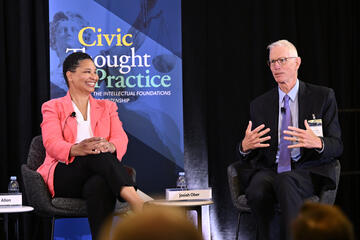



Four new projects have been selected for support from a joint initiative of Johns Hopkins University and the American Enterprise Institute designed to bring scholars from the two organizations together to work on research, teaching, or other pursuits—and to participate in the intellectual life of each other's institutions.
The JHU-AEI Fellowship Exchange Program supports projects co-led by a JHU faculty member or members and a scholar from AEI, a leading center-right think tank based in Washington, D.C. Eleven projects were selected for grant funding in September; those projects span a range of disciplines and topics, from the future of liberal education and the U.S. response to the COVID-19 pandemic, to scientific rigor in a time of research funding reform and controlling health care costs amid rising consumer frustration.
The four newly funded projects explore relevant present-day questions:
- How should universities navigate a rapidly changing policy and fiscal environment?
- How can trust be rebuilt between public health authorities and the public?
- What are the factors that shape Central American immigrants' decision to migrate to the U.S.?
- Can we improve the quality of the national conversation on America's evolving foreign policy role in the world?
Through its research, courses, and convenings, the fellowship program aims to model reasoned exchange across difference for students and scholars, build stronger bridges between the academy and the think tank sector, and emphasize the importance of bringing a broad range of perspectives and ideas into research that carries implications for the nation's common life.
Grants were awarded following a peer review of proposal by a committee of JHU faculty and AEI scholars. More information about the program is available on the provost's office website.
The four new projects selected for funding via the JHU-AEI Fellowship Exchange Program are:
Leading Colleges and Universities Beyond the Dismantling of the Education Department
A Research Project and Policy Summit
Joshua Brown (School of Education) & Gerard Robinson (AEI)
Two executive orders signed by the president of the United States in April 2025 aim to fundamentally reshape how accountability for colleges and universities is both monitored and maintained. One order gives universities the option to choose an accreditor, while the other executive order dismantles the Education Department. With these executive orders, senior university leaders are seeking to understand how to successfully guide their institutions through a rapidly changing policy and fiscal environment.
We propose a project that brings together researchers, university leaders, and higher education policy experts to create innovative solutions for these real-time challenges through a two-part initiative: a research project and policy summit. Most importantly, we invite graduate students—the future leaders who will inherit this new accountability system—to participate in this pivotal policy summit hosted at AEI national headquarters in Washington, D.C.
Do Public Health Experts Trust the Public?: Understanding and Rebuilding Trust Between the Public and Public Health Authorities
Roger Pielke, Jr. (AEI), Emily Gurley and Laura Beres (Bloomberg School of Public Health)
There are numerous extant surveys measuring public trust in science, health officials, and decision-makers. However, to our knowledge there are no surveys of public health officials' perspectives on trust in the public and in individual decision making about health. Numerous recent works in popular media have demonstrated that often people whose behaviors are at odds with health authorities' guidance have reasonable questions and concerns about that guidance. Taking a person-centered approach to communication and decision-making may support greater trust and better outcomes. This requires an understanding of how health officials approach public engagement around decision-making.
We propose a collaboration between AEI and Johns Hopkins, including joint research and public dialogue across difference, that can help shift the paradigm toward rebuilding trust in health and create a path for future partnerships across ideological difference. The project will engage scholars, students, and the public to implement a survey of public health authorities on trust in individual health decision-making and dialogue-based public dissemination to identify opportunities for trust building and future research questions.
Subjective Beliefs and Migration Decisions: A Large-Scale Survey of Potential Central American Immigrants to the U.S.
Nicholas W. Papageorge (Krieger School of Arts and Sciences), Michael R. Strain (AEI), Eleno Castro (Krieger School of Arts and Sciences), John Green (Krieger School of Arts and Sciences)
Economic research increasingly uses measures of subjective expectations to understand how individuals make choices, yet little data exist on potential migrants' beliefs about immigration risks, benefits, and costs. To address this gap, Johns Hopkins University and the American Enterprise Institute will jointly design and field a novel survey of Central American residents' migration plans and expectations.
This project will leverage AEI's policy expertise with JHU's academic research strength and prioritizes ideological inclusivity by systematically incorporating immigration theories from conservative, liberal, and bipartisan perspectives, ensuring our survey design can evaluate competing claims scientifically rather than foreclosing certain viewpoints from the outset. Through joint interdisciplinary meetings during survey development, we will create a comprehensive dataset of potential immigrants' subjective beliefs about factors affecting migration decisions, including wage differentials, security risks, and deportation likelihood. Deliverables include qualitative and quantitative datasets, a policy brief, and academic papers that improve understanding of how beliefs drive migration choices.
A Shared Foreign Policy Debate: Toward a Bipartisan Understanding of America's Role in the World
Peter Pomerantsev (SNF Agora Institute) and Dalibor Rohac (AEI)
America's role in the world is in flux. Polling and focus group work made available to JHU shows how American voters hold increasingly confused and fluid views about challenges and opportunities facing the nation's foreign policy. This project will gather think tank experts, academics, and journalists across the political spectrum and across intellectual perspectives to explore how to communicate foreign policy issues to the general public. We will also invite local media and local-level social media influencers into the conversation, as they are the people who engage important audiences.
We will build on the initial conversations to design survey research and qualitative analysis that can shed light on how foreign policy issues and information can be communicated to the American public. The results will be summarized in a guide on how to engage Americans on critical foreign policy questions in order to foster a common national conversation that will be of practical use to stakeholders.
Posted in University News, Politics+Society